
Heat Transfer Fluid – Thermal Fluids
Duratherm offers a wide range of thermal fluids (heat transfer fluid) for just about every application and uses anywhere from -84ºC (-120ºF) right up to 338ºC (640ºF). Most are non-toxic and non-hazardous, some even food-grade, but all are highly efficient, clean-running, and long-lasting.
Find your thermal fluid here or these pages for: Open Bath Fluids, System Cleaners, Glycol Coolants
Confused? We Can Help
Choosing a heat transfer fluid (also called thermal fluid or thermal oil) can be difficult decision. What makes one better than the other? Why do some last longer? How do I know which one is best for my application?
Truth is a lot of heat transfer fluids look alike and If specified properly, they all transfer heat efficiently — the difference is ours just tend to last longer. And while most of the time heat transfer fluids run trouble-free, you want to also choose a company who has the expertise and responsive support to help you when they don’t. All we do is heat transfer fluids and we spend every day helping the people that use them or need help choosing them.
Help is just a phone call or email away – our technical support team – not sales people – are readily available to learn more about your needs and application
Duratherm HF
Max Temp
338°C
Flash Point
277°C
Duratherm HF
Max Temp
640°F
Flash Point
530°F
Engineered for its high flash point of 277°C with an operating limit of 338°C, Duratherm HF offers a solution to those customers requiring the additional margin of safety needed to meet their own internal safety standards or those of their insurance carrier or government regulators.
Engineered for its high flash point of 530°F with an operating limit of 640°F, Duratherm HF offers a solution to those customers requiring the additional margin of safety needed to meet their own internal safety standards or those of their insurance carrier or government regulators.
- 277°C (530°F) flash point
- 338°C (640°F) maximum operating temperature
- Extensive additives for extended service life
- Strong resistance to oxidation
- Keeps systems running clean and efficiently
- Non-toxic and non-hazardous oil – requires no special handling
Duratherm HF-FG
Max Temp
338°C
Flash Point
277°C
Duratherm HF-FG
Max Temp
640°F
Flash Point
530°F
A food grade heat transfer oil rated to 338°C, Duratherm HF-FG is specifically engineered for process heating and cooling applications that need the added safety of a high flash point. Economical and thermally stable, it meets USDA requirements for incidental food contact, is NSF registered HT1, and meets the requirements of 21 CFR 178.3570.
A food grade heat transfer oil rated to 640°F, Duratherm HF-FG is specifically engineered for process heating and cooling applications that need the added safety of a high flash point. Economical and thermally stable, it meets USDA requirements for incidental food contact, is NSF registered HT1, and meets the requirements of 21 CFR 178.3570.
- Food grade – Kosher, NSF registered and meets FDA 21 CFR 178.3570
- 277°C (530°F) flash point, the highest rating of any food grade heat transfer oil
- 338°C (640°F) maximum operating temperature
- Engineered for use in a wide variety of food and beverage applications
- Runs cleaner with an extended service life
Duratherm 630
Max Temp
332°C
Flash Point
229°C
Duratherm 630
Max Temp
630°F
Flash Point
444°F
Rated to 333°C and engineered to be an economical and environmentally friendly replacement to chemical aromatic thermal fluids, Duratherm 630’s enhanced blend is designed to offer years of trouble free service and superior protection from oxidation even at higher operating temperatures.
Rated to 630°F and engineered to be an economical and environmentally friendly replacement to chemical aromatic thermal fluids, Duratherm 630’s enhanced blend is designed to offer years of trouble free service and superior protection from oxidation even at higher operating temperatures.
- 333°C (630°F) maximum operating temperature
- Clean alternative to synthetic, benzene based thermal fluids
- Engineered for precise temperature control
- Lubricates and extends the life of gaskets and seals
- Superior protection against sludge formation
- Non-toxic, non-hazardous
Duratherm FG
Max Temp
327°C
Flash Point
227°C
Duratherm FG
Max Temp
620°F
Flash Point
440°F
Rated to 327°C, It has a strong resistance to fouling for extended service and is engineered and manufactured to comply with the demands of food grade applications. Meets USDA requirements for incidental food contact (H1), meets the requirements of 21 CFR 178.3570 and is registered with the NSF HT1.
Rated to 620°F, It has a strong resistance to fouling for extended service and is engineered and manufactured to comply with the demands of food grade applications. Meets USDA requirements for incidental food contact (H1), meets the requirements of 21 CFR 178.3570 and is registered with the NSF HT1.
- Food grade - NSF registered and meets FDA 21 CFR 178.3570
- Rated to 327°C (620°F), it’s one of the highest temperature food grade thermal fluids available
- Kosher certified
- Extended service life
- Dual-stage anti-oxidant protects against oxidation
Duratherm HTO
Max Temp
316°C
Flash Point
218°C
Duratherm HTO
Max Temp
600°F
Flash Point
425°F
Engineered for precise and efficient temperature control up to 316°C, our HTO is a budget-wise solution for any heat transfer fluid applications that need an environmentally friendly, low cost fluid capable of meeting today’s fast-paced production demands.
Engineered for precise and efficient temperature control up to 600°F, our HTO is a budget-wise solution for any heat transfer fluid applications that need an environmentally friendly, low cost fluid capable of meeting today’s fast-paced production demands.
- 316°C (600°F) maximum operating temperature
- An economical option that outlasts the competition
- Environmentally friendly, non-hazardous and non-reportable
- Excellent thermal stability
- Contains antioxidants for added protection from oxidation
Duratherm S
Max Temp
316°C
Flash Point
324°C
Duratherm S
Max Temp
600°F
Flash Point
615°F
A silicone based fluid that is ideally suited for high oxidation applications or completely exposed systems. Duratherm S is virtually impervious to oxidation at temperatures under 204°C and offers superior protection from fluid degradation. Duratherm S is best suited for applications not prone to contamination or leaking.
A silicone based fluid that is ideally suited for high oxidation applications or completely exposed systems. Duratherm S is virtually impervious to oxidation at temperatures under 400°F and offers superior protection from fluid degradation. Duratherm S is best suited for applications not prone to contamination or leaking.
- 316°C (600°F) maximum operating temperature
- Pumpable down to -50°C (-46°F)
- Very strong resistance to oxidation up to 204°C (400°F)
- Recommended for use in fully exposed systems like open baths
- Highly resistant to fouling for an extremely long service life
- Non-corrosive and non-toxic thermal fluid for added workplace safety
Duratherm 600
Max Temp
316°C
Flash Point
224°C
Duratherm 600
Max Temp
600°F
Flash Point
435°F
Rated to 316°C and specifically engineered to withstand the extreme oxidation environment of open (to atmosphere) systems, Duratherm 600 incorporates a proprietary dual-stage anti-oxidant for long, trouble free operation in a variety of applications. It’s an environmentally friendly, non-toxic thermal fluid (heat transfer fluid) capable of providing precise temperature control.
Rated to 600°F and specifically engineered to withstand the extreme oxidation environment of open (to atmosphere) systems, Duratherm 600 incorporates a proprietary dual-stage anti-oxidant for long, trouble free operation in a variety of applications. It’s an environmentally friendly, non-toxic thermal fluid (heat transfer fluid) capable of providing precise temperature control.
- 316°C (600°F) maximum operating temperature
- A tough thermal fluid made for a variety of applications
- Engineered for use in heat transfer applications with exposure to air
- Superior protection against sludge and carbon formation
Duratherm HTO22-FG
Max Temp
316°C
Flash Point
213°C
Duratherm HTO22-FG
Max Temp
600°F
Flash Point
415°F
Duratherm HTO22-FG is rated to 315C and engineered with a low pour point for easy starting of systems in colder climates.
Duratherm HTO22-FG is rated to 600F and engineered with a low pour point for easy starting of systems in colder climates.
- 316°C (600°F) maximum operating temperature
- Food Grade – NSF registered HT1
- Environmentally friendly, non-toxic, non-hazardous and non-reportable.
- Superior protection against sludge and carbon formation
Duratherm HTO-FG
Max Temp
316°C
Flash Point
218°C
Duratherm HTO-FG
Max Temp
600°F
Flash Point
425°F
Engineered for precise and efficient temperature control up to 316°C, our HTO-FG is a budget-wise, food grade solution for any heat transfer applications that need an environmentally friendly, low cost fluid capable of meeting today’s fast-paced production demands.
Engineered for precise and efficient temperature control up to 600°F, our HTO-FG is a budget-wise, food grade solution for any heat transfer applications that need an environmentally friendly, low cost fluid capable of meeting today’s fast-paced production demands.
- 316°C (600°F) maximum operating temperature
- An economical option that outlasts the competition
- Food Grade Registered NSF HT-1
- Excellent thermal stability
- Contains antioxidants for added protection from oxidation
Duratherm G
Max Temp
260°C
Flash Point
249°C
Duratherm G
Max Temp
500°F
Flash Point
480°F
Rated to 260°C, a proprietary additive system not only helps Duratherm G last longer and run cleaner, it makes it the ideal choice for extreme oxidation environments including demanding, open bath applications.
Rated to 500°F, a proprietary additive system not only helps Duratherm G last longer and run cleaner, it makes it the ideal choice for extreme oxidation environments including demanding, open bath applications.
- 260°C (500°F) maximum operating temperature
- High flash point of 249°C (480°F)
- Ideal for use in extreme oxidation environments like open baths
- Polyalkylene glycol based thermal fluid with enhanced performance
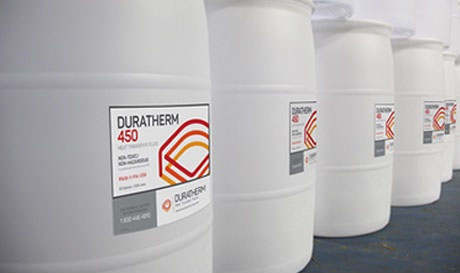
Duratherm 450
Max Temp
232°C
Min Temp
-24°C
Flash Point
150°C
Duratherm 450
Max Temp
450°F
Min Temp
-20°F
Flash Point
302°F
Rated to 233°C, Duratherm 450 is specifically engineered for applications requiring a thermal fluid capable of efficient process heating and cooling. Economical and thermally stable, it provides precise temperature control and is proven to be an excellent alternative to costly synthetics and aromatic fluids.
Rated to 450°F, Duratherm 450 is specifically engineered for applications requiring a thermal fluid capable of efficient process heating and cooling. Economical and thermally stable, it provides precise temperature control and is proven to be an excellent alternative to costly synthetics and aromatic fluids.
- 233°C (450°F) maximum operating temperature while cooling properties
- Cold temperature pumpability down to -45°C (-49°F)
- Recommended for precise control of heating and cooling cycles
- Economical alternative to costly synthetics and aromatics
- Long lasting and environmentally friendly
- Uses a dual-stage anti-oxidant to resist oxidation
Duratherm 450-FG
Max Temp
232°C
Min Temp
-24°C
Flash Point
150°C
Duratherm 450-FG
Max Temp
450°F
Min Temp
-20°F
Flash Point
302°F
A food grade heat transfer fluid rated to 233°C, Duratherm 450-FG is made for applications in the food industry that need both process heating and cooling. Cost effective and stable across a wide temperature range, it meets USDA’s standards for incidental food contact, is NSF registered as HT1, and meets the requirements of 21 CFR 178.3570.
A food grade heat transfer fluid rated to 450°F, Duratherm 450-FG is made for applications in the food industry that need both process heating and cooling. Cost effective and stable across a wide temperature range, it meets USDA’s standards for incidental food contact, is NSF registered as HT1, and meets the requirements of 21 CFR 178.3570.
Duratherm LT
Max Temp
225°C
Flash Point
165°C
Duratherm LT
Max Temp
437°F
Flash Point
329°F
Engineered for a variety of applications requiring process heating and cooling, Duratherm LT is ideal for batch processing operations requiring a thermal fluid that is pumpable down to -30°C – eliminating the need for heat tracing often required in outdoor applications.
Engineered for a variety of applications requiring process heating and cooling, Duratherm LT is ideal for batch processing operations requiring a thermal fluid that is pumpable down to -20°F – eliminating the need for heat tracing often required in outdoor applications.
- 225°C (437°F) maximum operating temperature with excellent cooling properties
- Pumpable at temperatures down to -29°C (-20°F)
- Capable of performing both heating and cooling cycles
- Suitable for use in outdoor heating and cooling applications
- Runs cleaner for a longer service life
- Easy to dispose of along with other waste oils
Duratherm XLT-2
Max Temp
177°C
Flash Point
63°C
Duratherm XLT-2
Max Temp
350°F
Flash Point
145°F
Engineered for long-term operation in heat transfer applications requiring precise temperature control ranging from -84°C up to 177°C
Engineered for long-term operation in heat transfer applications requiring precise temperature control ranging from -120°F up to 350°F
- Maximum temperature: 177ºC/350°F
- Minimum temperature: -84ºC/-120°F
- Flash point 63ºC/145°F
- Extreme low-temperature capabilities
- Stable and non-corrosive
- Properties remain consistent over temperature range
- Includes free fluid analysis and tech support
