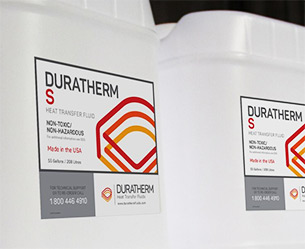
Heat Transfer Fluid
Duratherm S
- "Duratherm saves money in the long run." — J. Smith
- "I've even recommended Duratherm to the equipment manufacturer." — Ed Slack
- "We have had no issues with Duratherm versus the old oil we were using." — J. Cowger Jr.
- "I've had zero failures in over a year-and-a-half since using Duratherm." — R. Barnett
- "Duratherm provides excellent heat transfer characteristics." — Ryan Seward
- "Yet another bonus was that the pricing was below comparable fluids." — S. Bailey Sr.
- "Duratherm is working great." — K. Rose
- "Duratherm is the best heat transfer fluid we've ever used." — Larry Daniels
- "This stuff is pretty amazing." — Ryan Seward
- "Duratherm HF has been performing remarkably well." — Raghu Kamath
- "The fluid is still clear … I can see the bottom of the tanks." — S. Bailey Sr.
- "A few companies along the way have been helpful, but none like Duratherm." — K. Rose
- "Duratherm G is working excellently!" — Ian Smiley
- "The heat transfer works better than any of the other fluids we have tried." — Lars Hvalby
- "We have increased the time between oil changes and nearly eliminated any issues." — J. Smith
- "I would highly recommend this product over any other heat transfer fluid." — J. Cowger Jr.
- "Duratherm is working great." — J. Cowger Jr.
- "Our oxidation problems have disappeared." — H. Blair
- "Duratherm does not sludge up at all." — Bill Corbett
- "I commend you on the quality and longevity of your products." — H. Blair
- "Duratherm 600 is the best fluid we’ve ever used!" — John Wanninger
- "Duratherm XLT-120 is exactly what we needed!" — Luke Colby
- "This will definitely be my go-to fluid for future projects." — Ryan Seward
- "Duratherm was one of the best moves we made. Working great!" — Neil McDivitt
- "These products performed exceptionally well for us." — S. Poletto
- "The fluid is working better than expected." — Dick Livingston
- "The difference between Calflo and Duratherm was amazing." — J. Gerbec
Duratherm S heat transfer fluid is ideal for applications such as negative pressure mold heaters, annealing tanks, open bath forming, or any processing equipment where oxidation is prevalent and problematic. Duratherm S heat transfer fluid resists the effects of oxidation seen with most other heat transfer fluids.
High-temperature stability is maintained to 650°F.This combined with a low end working temperature of -40°F also makes Duratherm S heat transfer fluid ideally suited for low-temperature applications, batch processing or any application requiring a single fluid for both heating and cooling.
Duratherm S is an extremely oxidative and thermally stable heat tranfer fluid offering precise temperature control in applications requiring the highest level of oxidative stability with high- and low-termperature workability.
The Difference
- Superior oxidation resistance∗ (virtually unaffected)
- Non-fouling - extremely long life
- Low odor
- Non-corrosive
- Non-hazardous
- Non-toxic
- Extremely high working temperature (650°F)
- Extremely low working temperature (-40°F)
Lasts Longer
Duratherm S heat transfer fluid is a high-performance, extremely stable, long-lasting silicone-based heat transfer fluid.
Virtually unaffected by oxidation∗, Duratherm S heat transfer fluid is perfect for use in a variety of applications requiring a safe, non-reportable, non-toxic and non-corrosive heat transfer fluid.
∗Call for application recommendations.
Tools
| Duratherm S Properties | ||
|---|---|---|
| Appearance: clear liquid, slight yellow tint | ||
| Maximum bulk Temp. (Closed System) | 650°F | 343°C |
| Maximum bulk Temp. (Open System) | 400°F | 204°C |
| Flash Point ASTM D92 | 615°F | 323°C |
| Fire Point ASTM D92 | 636°F | 335°C |
| Autoignition ASTM E-659-78 | 818°F | 436°C |
| Viscosity ASTM D445 | ||
| cSt at -58°F / -50°C | 334.2 | |
| cSt at -13°F / -25°C | 177.4 | |
| cSt at 100°F / 38°C | 37.5 | |
| cSt at 212°F / 100°C | 17.4 | |
| cSt at 500°F / 260°C | 4.4 | |
| cSt at 600°F / 316°C | 3.3 | |
| Pour Point ASTM D97 | -87°F | -66°C |
| Density ASTM D1298 | lb/ft3 | g/ml |
| at 100°F / 38°C | 59.7 | 0.956 |
| at 500°F / 260°C | 53.4 | 0.855 |
| at 600°F / 316°C | 51.8 | 0.829 |
| Carbon Residue ASTM D189 | 0.01 | % Mass |
| Sulphur Content X-RAY | <.001 | weight % |
| Thermal Expansion Coefficient | 0.055 %/°F | 0.105 %/°C |
| Thermal Conductivity | BTU/hr F ft | W/m K |
| at 0°F / -17°C | 0.081 | 0.140 |
| at 100°F / 38°C | 0.075 | 0.129 |
| at 300°F / 148°C | 0.061 | 0.105 |
| at 500°F / 260°C | 0.048 | 0.083 |
| at 600°F / 316°C | 0.042 | 0.072 |
| Heat Capacity | BTU/lb F | kJ/kg K |
| at 0°F / -17°C | 0.382 | 1.599 |
| at 100°F / 38°C | 0.403 | 1.687 |
| at 300°F / 148°C | 0.449 | 1.879 |
| at 500°F / 260°C | 0.495 | 2.072 |
| at 600°F / 316°C | 0.518 | 2.168 |
| Vapor Pressure ASTM D2879 | psi | kPa |
| at 100°F / 38°C | 0.00 | 0.00 |
| at 500°F / 260°C | 0.30 | 2.06 |
| at 600°F / 316°C | 1.01 | 6.96 |
*The values quoted in the table above are typical of normal production. They do not constitute a specification.

Technical Papers
Heat Transfer Fluid Basics
- Understanding Fluid Degradation
- Understanding Flash, Fire and Auto Ignition Points
- Avoiding Oxidation and Thermal Degradation
Selecting a Fluid
- Thermal Fluid Selection Guide for Systems Under 250 Gallons
- Thermal Fluid Selection Guide for Systems Over 250 Gallons
- Open Baths and Heat Transfer Fluids