Heat Transfer Fluid
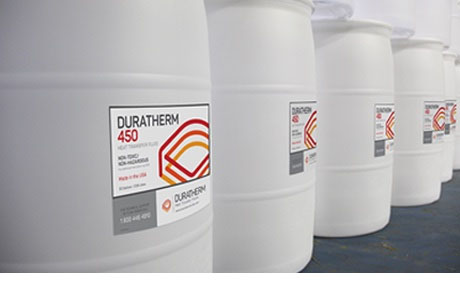
Duratherm 450FG
- "The fluid is still clear … I can see the bottom of the tanks." — S. Bailey Sr.
- "Duratherm is working great." — J. Cowger Jr.
- "Our oxidation problems have disappeared." — H. Blair
- "I've even recommended Duratherm to the equipment manufacturer." — Ed Slack
- "Duratherm 600 is the best fluid we’ve ever used!" — John Wanninger
- "We have increased the time between oil changes and nearly eliminated any issues." — J. Smith
- "I would highly recommend this product over any other heat transfer fluid." — J. Cowger Jr.
- "The heat transfer works better than any of the other fluids we have tried." — Lars Hvalby
- "Duratherm XLT-120 is exactly what we needed!" — Luke Colby
- "Duratherm provides excellent heat transfer characteristics." — Ryan Seward
- "A few companies along the way have been helpful, but none like Duratherm." — K. Rose
- "Duratherm was one of the best moves we made. Working great!" — Neil McDivitt
- "Duratherm G is working excellently!" — Ian Smiley
- "This will definitely be my go-to fluid for future projects." — Ryan Seward
- "Yet another bonus was that the pricing was below comparable fluids." — S. Bailey Sr.
- "Duratherm HF has been performing remarkably well." — Raghu Kamath
- "This stuff is pretty amazing." — Ryan Seward
- "We have had no issues with Duratherm versus the old oil we were using." — J. Cowger Jr.
- "Duratherm is working great." — K. Rose
- "Duratherm does not sludge up at all." — Bill Corbett
- "I commend you on the quality and longevity of your products." — H. Blair
- "These products performed exceptionally well for us." — S. Poletto
- "Duratherm saves money in the long run." — J. Smith
- "The difference between Calflo and Duratherm was amazing." — J. Gerbec
- "I've had zero failures in over a year-and-a-half since using Duratherm." — R. Barnett
- "The fluid is working better than expected." — Dick Livingston
- "Duratherm is the best heat transfer fluid we've ever used." — Larry Daniels
Duratherm 450FG is rated for use up to 450°F and ideal for applications such as blow molding, injection molding or any application where lower working temperatures are required or for applications requiring both heating and cooling cycles between 30°F and 450°F.
Duratherm 450FG meets USDA requirements for incidental food contact and NSF registered HT1 and meets the requirements of 21CFR1783570.
The Difference
Our exclusive additive package, including a proprietary dual-stage antioxidant, ensures long, trouble-free operation. Duratherm 450FG also incorporates metal deactivators, a seal and gasket extender, and defoaming and particle-suspension agents.
Lasts Longer
In the heat transfer fluid industry, cost is always a concern. However, fluid longevity and resistance to harmful fouling are of equal importance.
Air contact is normally detrimental to a fluid. Oxidation can cripple your system and, if left unchecked, will ultimately cause catastrophic failure. Unscheduled downtime due to oil failure has a high cost and negative effect on production.
The Duratherm product line was developed with this in mind. Most other fluids fall short in their protection from oxidation and can quickly foul a system. Duratherm is engineered to give unsurpassed levels of protection and service life.
Environmental
Duratherm 450FG is environmentally friendly, non-toxic, non-hazardous and non-reportable. Worker health and safety is of great concern, Duratherm 450FG poses no ill effect to worker safety. After its long service life, it can easily be disposed of with other waste oils.
Tools
| Duratherm 450FG Properties | ||
|---|---|---|
| Appearance: colorless, clear and bright liquid | ||
| Maximum bulk/use Temp. | 450°F | 232°C |
| Flash Point ASTM D92 | 302°F | 150°C |
| Fire Point ASTM D92 | 327°F | 163°C |
| Autoignition ASTM E-659-78 | 625°F | 329°C |
| Viscosity ASTM D445 | ||
| cSt at 104°F / 40°C | 4.8 | |
| cSt at 250°F / 121°C | 1.3 | |
| cSt at 450°F / 232°C | 0.6 | |
| Pour Point ASTM D97 | -49°F | -45°C |
| Density ASTM D1298 | lb/ft3 | g/ml |
| at 100°F / 38°C | 53.1 | 0.850 |
| at 250°F / 121°C | 49.5 | 0.792 |
| at 450°F / 232°C | 44.8 | 0.717 |
| Average Molecular Weight | 372 | |
| Carbon Residue ASTM D189 | 0.005 | % Mass |
| Sulphur ContentX-RAY | <.001 | weight % |
| CU Strip Corrosion ASTM D130 | 1a | |
| Thermal Expansion Coefficient | 0.0564 %/°F | 0.1016 %/°C |
| Thermal Conductivity | BTU/hr F ft | W/m K |
| at 100°F / 38°C | 0.082 | 0.141 |
| at 250°F / 121°C | 0.079 | 0.136 |
| at 450°F / 232°C | 0.074 | 0.128 |
| Heat Capacity | BTU/lb F | kJ/kg K |
| at 100°F / 38°C | 0.510 | 2.135 |
| at 250°F / 121°C | 0.570 | 2.386 |
| at 450°F / 232°C | 0.650 | 2.721 |
| Vapor Pressure ASTM D2879 | psi | kPa |
| at 100°F / 38°C | 0.09 | 0.62 |
| at 250°F / 121°C | 0.33 | 2.27 |
| at 450°F / 232°C | 3.23 | 22.27 |
| Distillation Range ASTM D2887 | 10% | 481°F (249°C) |
| 90% | 851°F (455°C) | |
*The values quoted in the table above are typical of normal production. They do not constitute a specification.

Technical Papers
Heat Transfer Fluid Basics
- Understanding Fluid Degradation
- Understanding Flash, Fire and Auto Ignition Points
- Avoiding Oxidation and Thermal Degradation
Selecting a Fluid
- Thermal Fluid Selection Guide for Systems Under 250 Gallons
- Thermal Fluid Selection Guide for Systems Over 250 Gallons
- Open Baths and Heat Transfer Fluids